Online ID Scanner vs. In-Person Verification: Which Is Right for Your Business
Identity fraud is one of the fastest-growing challenges in modern business operations. Billions of dollars are lost each year due to fraudulent identities, fake documents, and unauthorized access — a problem that spans industries from financial services and healthcare to hospitality and retail. As businesses scale and customer interactions increasingly shift to digital channels, the question is no longer whether to verify identity, but how to do it most effectively.
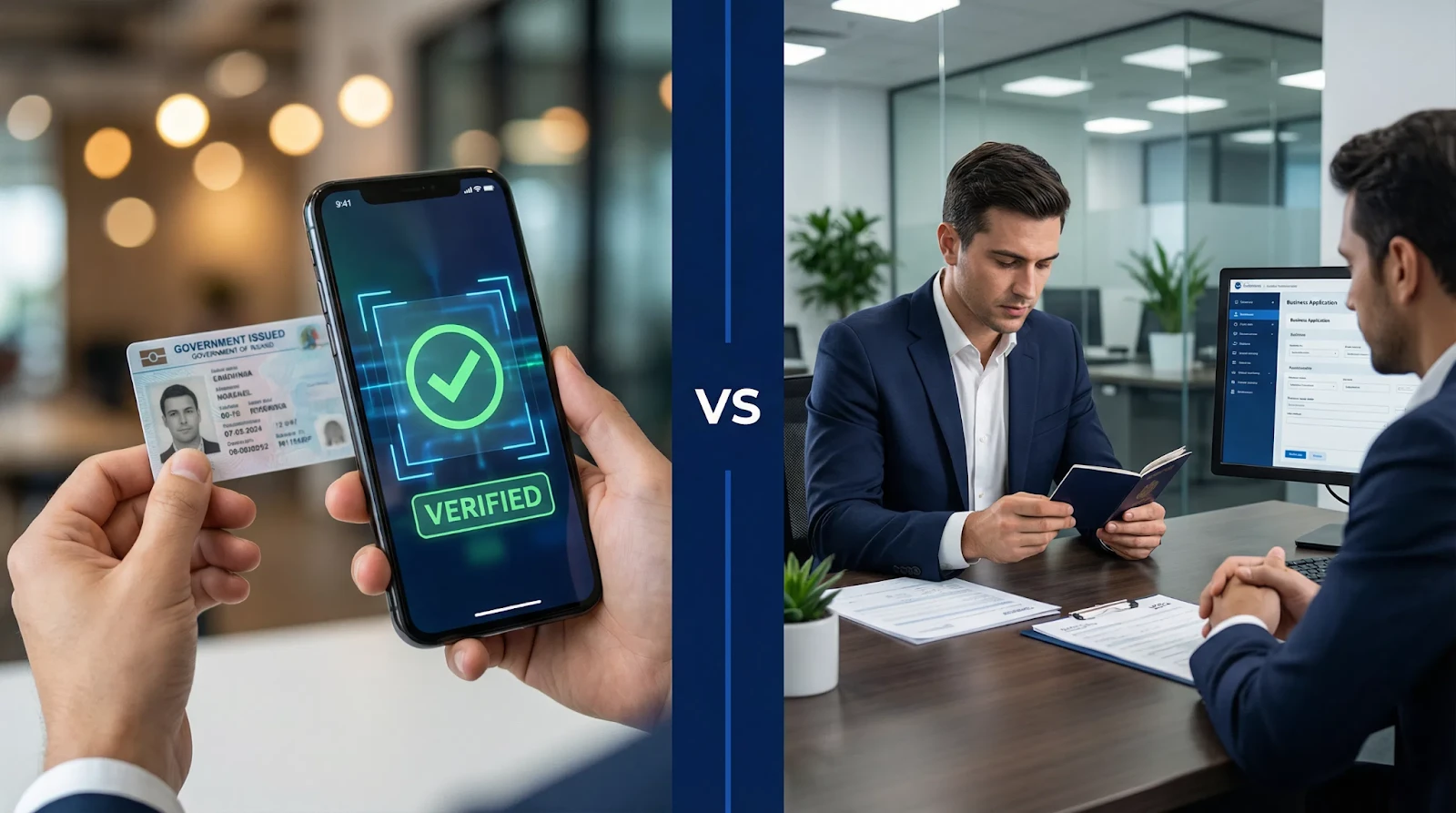
Two primary approaches dominate the market today: traditional in-person verification and digital identity solutions. Choosing between them is not simply a matter of preference — it directly affects operational efficiency, customer experience, compliance posture, and ultimately, the bottom line. Given this, businesses need a clear framework for evaluating both options before committing to one.
What Is Identity Verification — and Why Does It Matter?
Identity verification is the process of confirming that a person is who they claim to be, typically by validating a government-issued document such as a passport, driver’s license, or national ID card. Traditionally, this process was handled face-to-face by a trained staff member. Today, however, digital solutions have fundamentally changed what’s possible.
An online ID scanner is a software-based tool that allows businesses to capture, extract, and validate identity document data remotely or at a point of interaction — without requiring a human agent to manually inspect the document. In other words, it automates the verification workflow by using optical character recognition (OCR), machine learning, and database cross-referencing to authenticate IDs in seconds.
What is also important here is that identity verification is increasingly becoming a regulatory requirement. Sectors such as banking, fintech, healthcare, and gaming are subject to Know Your Customer (KYC) and Anti-Money Laundering (AML) compliance frameworks, making robust identity verification not optional, but mandatory.
When Does In-Person Verification Make Sense?
In-person verification remains the preferred approach in contexts where physical presence is inherent to the service — including, but not limited to:
- High-security environments such as government offices or border control
- Premium banking or financial advisory services
- Age-restricted retail with low transaction volume
- Healthcare settings where patient identity must be confirmed with certainty
In these scenarios, a trained staff member can visually inspect holograms, watermarks, and other physical security features that even sophisticated software might miss under poor conditions.
Key Limitations of In-Person Verification
Despite its reliability in controlled settings, in-person verification carries significant drawbacks:
- Scalability issues: As customer volume grows, staffing requirements grow with it.
- Human error: Fatigue, distraction, or insufficient training can lead to missed fraud attempts.
- Speed: Manual checks create bottlenecks, particularly during peak hours.
- Geographic constraints: Physical verification is simply not possible for remote or digital-first customer journeys.
From a financial perspective, maintaining a team dedicated to manual verification is significantly more expensive than deploying an automated solution — especially at scale.
When Does It Make Sense to Use an Online ID Scanner?
Digital identity verification tools are particularly well-suited for businesses that operate online, manage high volumes of onboarding, or need to verify identities across multiple locations simultaneously. The most highly demanded options are found in:
- Fintech and banking: Customer onboarding, account opening, loan applications.
- E-commerce and marketplaces: Seller verification, age-gating for restricted products.
- Healthcare: Patient registration and telehealth access.
- Hospitality: Remote check-in processes for hotels and car rental services.
- HR and hiring platforms: Candidate background verification.
That’s why the global identity verification market has been growing consistently, driven by the accelerating shift toward digital-first business models.
Key Features of Reliable Online ID Scanning Solutions
You should look for platforms that combine several critical capabilities. A dependable online ID verification system should offer:
- Document recognition across multiple formats: Passports, national IDs, driver’s licenses from numerous countries.
- OCR and data extraction: Automatic reading of machine-readable zones (MRZ), barcodes, and text fields.
- Liveness detection: Confirms the person presenting the document is physically present, reducing spoofing attempts.
- Database cross-referencing: Matches extracted data against government or third-party databases.
- Fraud detection algorithms: Flags tampered documents, inconsistent fonts, or missing security features.
- Compliance support: Built-in KYC/AML reporting capabilities.
- API integration: Seamlessly connects with existing CRM, onboarding, or access management systems.
Apart from this, pay attention to whether the solution supports real-time verification — delays in the verification workflow can significantly impact conversion rates during digital onboarding.
Conclusion
Identity verification is not a one-size-fits-all challenge. In-person verification offers reliability and human judgment in physical settings, but it scales poorly and introduces operational costs that grow with volume. Digital solutions — particularly those built around an intelligent online ID scanner — enable businesses to verify identities accurately, rapidly, and at scale, while supporting compliance requirements across industries.
The majority of forward-thinking businesses are moving toward automated, API-driven verification as a foundation — supplemented by in-person checks where the context genuinely demands it. You should attentively analyze whether your current verification process is serving your business or slowing it down. In many cases, the answer will point clearly toward a smarter, more scalable digital approach.